Wednesday, 31 March 2010

[cartoon] Arsenal - Barcelona

[Adrian Georgescu] Da, Raul la Liverpool!


Ar fi ca şi cum un rege, Gerrard Magnificul, i-ar acorda unui alt suveran adăpost la curtea Sa.

De câte ori îl văd încălzindu-se pe marginea terenului, prin minutul 75 al unui meci, îmi imaginez că, nu cu mult timp în urmă, curăţa cartofi într-o bucătărie din subsolul clubului şi, aflând că este nevoie de el, a pus şorţul deoparte şi s-a echipat pe o scară întunecoasă. Mă gândesc că Raul ar face orice pentru Real Madrid, dacă şi cei patru fii ai săi sunt numiţi după câte un jucător emblematic al acestui club.

Fotbalistul care în toată cariera sa de profesionist nu a primit un cartonaş roşu vede acum unul din partea propriului club, căruia i-a fost fidel mereu. Desigur, nu i se spune în faţă “Nu mai ai loc”, ci, în calda tradiţie corporatistă, i se dă de înţeles că “Postul pe care dumneavoastră evoluaţi e fost desfiinţat”. Şi nu e vorba de locul în aşezarea din teren – pentru că Raul ar putea juca oriunde în ofensivă: extremă, vîrf sau în spatele vîrfurilor -, ci mai degrabă, e vorba de postul de “simbol”.

Mi-l amintesc pe Baresi ţinut la AC Milan până la 37 de ani în teren, când marele Franco a simţit că nu mai poate şi s-a retras. Sau de Paolo Maldini, care a spus adio în 2009, la 40 de ani. La celălalt “diavol”, Giggs (36 de ani) şi Scholes (35) joacă încă, cu contracte prelungite. În acelaşi timp, la doar 32 de ani, recordmanul golurilor înscrise pentru clubul madrilen n-a mai avut loc în echipa de start nici într-o treime dintre meciurile disputate în acest sezon.

Sunt, desigur, scheme de cucerire ale Universului care îl exclud, deşi “galacticii” n-au mai prins cam de multişor o semifinală nu într-o competiţie desfăşurată pe undeva pe la marginea Căii Lactee, ci chiar aici, pe Pămînt: Liga Campionilor. Da, pentru al cincilea an consecutiv, Real Madrid e clubul cu cele mai mari încasări din lume, 400 milioane de euro în sezonul trecut, însă pare mai degrabă toana unui băieţel de patru ani de a nu mai da drumul din mână unor abţibilduri, decât după ce s-a plictisit de ele. Makelele, Robben, Sneijder şi mulţi alţii pot depune mărturie despre deliciile meseriei de pion otrăvit.

Sper ca Raul Gonzalez să accepte oferta lui Benitez şi să ajungă la Liverpool, pentru că blestemul Realului este că va rămâne “Raul Madrid” chiar fără să o ştie şi fără să o vrea. Aştept ziua în care vor vinde şi albul din echipament pentru a cuceri o piaţă prin Asia, când Cristiano Ronaldo şi alţii ca el vor scoate puţin fum din frezele ca mucul de lumânare, evaporându-se ca nişte holograme cuminţi. Ce vis! Raul alături de Gerrard ar fi ca şi cum un rege i-ar acorda unui alt suveran adăpost la curtea sa, iar fotbalul ar redeveni o ocupaţiune în care să mai fie loc pentru tradiţie, respect şi recunoştinţă.

Friday, 26 March 2010

[Sid Lowe] Players taking advantage of good sportsmanship

Iker Casillas was going mental, shouting and swearing and waving his arms in the air. Angrily, he refused to shake hands with Dani Parejo - a former teammate and quite possibly a future one, too. The rest of the Real Madrid team shook their heads sadly, looking stunned. And the coach, Manuel Pellegrini, was furious.

"I don't think anyone can be proud of what happened," he said. "I certainly wouldn't want my team to do something like that. What Dani Parejo did was very disloyal."

What Dani Parejo did was this: he tackled Iker Casillas, played the ball to a teammate, got the return pass, and scored.

There really isn't very much more to it.

Pellegrini outraged


Only, it seems, there is. There is very, very much more to it. And that has once again revealed the ridiculousness of one the most infuriating habits that has taken hold of the Spanish league, the double standards, gamesmanship and rank hypocrisy.

Real Madrid were playing at Getafe on Thursday night. Madrid were 4-0 up - yes, four; we're not even talking about a decisive moment, a match changing play - when a ball was crossed into the box.

Casillas came flying off his line, flapped at the cross, palming the ball out of the area and chased after it like a man possessed. Parejo made the challenge (cleanly, it appears), Casillas tumbled over him, and Parejo found a teammate inside the area.

When the teammate played the ball back to Parejo, Casillas was still on the floor, rolling round and making a fuss, but Madrid had four defenders between Parejo and the goal. One or two seemed to half-stop, others didn't. Parejo curled in a clever finish.

Casillas was furious. Pellegrini, too. They expected and demanded that Parejo kick the ball out of play. But why should he?

First of all, did Parejo even see Casillas on the floor? Maybe, maybe not. Probably yes, in truth - but that's not the point. The point is this: there was no foul. And even if there had been, that's up to the referee.

There was no injury. Although Casillas made a song and dance of being hurt and Pellegrini said afterwards, "he has a knock on his ankle you should see", he carried on for the rest of the match. He won't miss training this morning or Sunday's match against Atletico Madrid.

Even if he had been injured, so what? There was no clash of heads, no terrible fall onto his neck from a great height, no blood gushing across the turf. At most there was a wallop on the ankle. So what? It happens.

Would kicking the ball out and getting the trainer on extra quick have made a major difference to his recovery? Why should anyone stop for an injury? If a full-back is struggling with cramp does the winger agree not to run at him? Of course not.

Why does Parejo owe loyalty to Casillas? Wouldn't not scoring have been disloyal to Getafe? The club he plays for. The club that pay him.

And what's to say that Casillas wasn't rolling about a bit precisely to try to force Parejo to kick the ball out and thus rescue his own stupid mistake and prevent Getafe from scoring a goal they had every right to score? 

And that is exactly the point. Kicking the ball out when a player goes down began as an act of sporting behaviour. But it has become exactly the opposite. It has been manipulated and taken advantage of. If you expect players to police themselves they will cheat. And now they cheat all the time - and yet, morally, they're the good guys; if he doesn't take the bait, the poor sod who's being cheated is the bad guy.

It may not have been the case with Casillas last night but players who invariably have absolutely nothing wrong with them have realised that going down is a great way of stopping the other side building a move, or launching a counter-attack or, like last night, scoring a goal. You can see them on the floor, eyes darting about, looking round to see if staying down and rolling about a bit is a good idea. If their team wins the ball back, magically they're ok again.

Other players then feel a kind of moral obligation to kick the ball out. But they shouldn't. It's twisted. It's upside down. It's just wrong. The moral obligation should be to carry on. The moral obligation should be to get back on your feet, there's nothing wrong with you. And even if there is, hey, tough luck, that's the way it goes sometimes.

Sportsmanship being taken advantage of


How often have you seen the player who's gone down actually need treatment? (and even if he does, so what?) It's as if the very fact of kicking the ball out is the magical cure his injury needs. And then when the other team, in a gesture of reciprocated 'goodwill', give the ball back they invariably give it back 50 yards further back and having had time to regroup. A good chance becomes a throw-in by your own by-line, right down in the corner. Hey, thanks mate! That's real sporting!

The sporting gesture was open to abuse and got abused; the sporting gesture became one of the least sporting things you could wish to see. And just another impediment to everyone's enjoyment. Game after game gets slowed, broken up, ruined - yes, even ruined - by the constant booting the ball out for no reason whatsoever. The moral pressure is too great for anyone to withstand.  

A couple of years ago, the then-Valladolid coach Jose Luis Mendilíbar, also getting pretty annoyed with the trend, announced that his side would not kick the ball out ever. And that he didn't expect any other team to kick the ball out for his players too. Before every game, he personally informed the referee of the decision and went to the opposition dressing room to tell them too.

If there's anything serious, he said, let the referee stop the game. He didn't because there wasn 't. The difference may not have been huge, but games flowed that little bit more.

Sadly, the example never caught on.

Last night, Manuel Pellegrini complained that Getafe's goal - a goal that made absolutely no difference whatsoever - was unsporting. Last week, he said nothing of the sort when Rafael Van der Vaart controlled with his hands - yes, both of them - to score the vital equaliser against Sporting Gijón.

Ah, he'd say, but that's up to the ref to see. And last night's wasn't? The player who got it wrong last night was Casillas, yet the pariah this morning is Parejo.

Last night Dani Parejo scored while Iker Casillas was on the floor.

Good.

Thursday, 25 March 2010

[totalBarca] Lessons from the Ibrahimovic-Eto’o comparison

Lessons from the Ibrahimovic-Eto’o comparison

Originally titled “‘IbracadARRRGGHHHH how could he scuff that one?!’ A culé considers requesting a refund,” I decided that was too harsh and not really what I’m arguing. But I miss Sammy, and I’m getting tired of watching Ibra pout on the field. So I went looking for constructive criticisms….

The same thing that makes football the most beautiful sport in the world also makes it very difficult to win an argument about a player. There are few statistics in football, and fewer still that do anything to capture a player’s value to his club. So I am waltzing into very subjective territory. Clearly, many of us enjoy these arguments — but let’s accept that there’s no winning to be done by anyone here. That job belongs to our players.
Let me add to that disclaimer a confession: I have waffled back and forth on the subject of Zlatan Ibrahimovic more times than Sergio Ramos runs a brush through his hair each morning. Even at the time of this writing, I am not sure precisely how to feel about the man. He is our striker and I know he can succeed here. Eto’o is gone and not returning, and I hope Ibra can look to his legacy to help raise his form.

Big Game Sammy has struggled to fit into his new side, too-- but came up big at Chelsea

There are several ways in which Zlatan is an improvement at CF over my beloved Cameroonian.
1) He is simply massive.At 6′3″ and 185 lbs (1.91m/84kg), he simply has a much larger frame than Eto’o, making him (at the very least) a more dangerous target from set pieces.
2) His ball skillsare of the very highest level, meaning he should be able to hold the ball up in the rare situations where opponents– British ones, probably– smother out our normal flair in midfield and make possession harder to maintain. Samu is certainly an accomplished settler and dribbler of the football, but those skills are not what made him such an assassin. More on this in a moment.
3) Wizardry:Ibra has the same reputation for cold-blooded finishing — a phrase which Eto’o should probably put on his business cards — but in the past he has always seemed to make something from nothing, and to create chances for himself and others. And he makes individual plays that rip culés out of our seats, even when they come to nothing. In a Liga game this season, for example, he was whistled for a high boot after using an impossible little Tae Kwan Do kick to bring the ball away from two defenders while it was well above his head height (and I wet myself in awe and cursed the referee).

But over the course of the season, as we wait patiently for Zlatan to find his place in the side, he has proven to be an inconsistent performer. His shortcomings also contrast sharply with Eto’o — though this time the comparison is not flattering to the Swede. Consider:
A) Lack of focus:Ibrahimovic fails to hustle back onside when possession is lost or his run forward does not earn him the ball. He certainly does not lack the pace and he is experienced enough that he should know better. He shows a tendency to dwell on misplayed balls, and is often seen shaking his head and walking/jogging back toward an onside position. I can’t count how many times this has happened this year, and I’m sure Eto’o was not perfect in this regard — but I know he worked harder to make sure he was in the right position as quickly as possible. And the one word that embodies his play, even when his form slips, is “hustle.”
B) Easily frustrated:This is related to the above point, as I think Ibra has very high standards for himself and he has not often reached them this season. He is a passionate player who wants nothing less than excellence from himself and his teammates, and that is a good thing. But he lets his emotions get the better of him on a regular basis. Sometimes that affects his focus (see above), but sometimes it seems to lead him into rough challenges and ugly verbal exchanges. Even when he does not accumulate cards or do something unsportsmanlike, that sort of behavior affects the whole side. It is unprofessional and it distracts teammates from the game at hand. Eto’o is not immune to frustration, of course, but makes a habit of channeling his frustration into running farther and working harder to repossess the ball. Thus far, Ibra has not found a creative outlet for his angst.
C) Inconsistent effort: It was always going to be complicated to fit a lone-striker type into the “total football” or Pep-ball system that raked in the hardware last season. Indeed, the only part of Rakun’s piece that I completely agree with is the notion that Pep deserves much of the blame for failing to put Ibra in a position to succeed. But I also think that a professional athlete in a slump has one thing completely in their control: ”How hard am I going to work?” We have seen the Swede be brilliant when he puts in the work — If he played each week as he did against Zaragoza on Sunday, we could applaud his effort just as we lament his finishing. It is that up-and-down performance that frays my nerves. At times, he does fight for possession, he does sprint everywhere and he does show with each touch that he’s ready for the ball. But only at times. Too often he is starved for the ball, and it shows in sloppy touches or scuffed chances at the goal mouth.

Zlatan is a warrior-- when he wants to be
So we return to the notion that Eto’o and Ibrahimovic are completely different types of players. Lord knows Samu missed his fair share of so-called “easy chances.” (Heck, somebody even made a video compilation of his misses.) But because he is a different kind of striker, and because he is constantly engaged in the game whether or not the ball comes to him, he always found himself with multiple chances per game — and so the misses fade in our memory.
Zlatan, on the other hand, needs the ball at his feet; he needs to be a target when Pep leaves him high and alone; he needs to be a part of the buildup when the strategy calls for multiple players to share the high striker role. We need to find a way to set him up for success (and again, we have not done so very often this year). I suspect we may need to let him run free much as Samu always did, but I’m no strategic expert.
Here’s what we really need: the Swede must improve the things he can control, regardless of what happens in each game. We need him to follow the Cameroonian’s example with his mentality about the game, and surely that will allow his natural creativity and skill to shine.
We need a focused, humble, hard-working and professional Zlatan Ibrahimovic — because that man is a deadly, world-class striker AND a brilliant distributor of the ball to his teammates. When he shows up, he is a joy to watch. Please, Ibra, start showing up every week.

Monday, 22 March 2010

[The Guardian] Man ... Superman ... Leo Messi


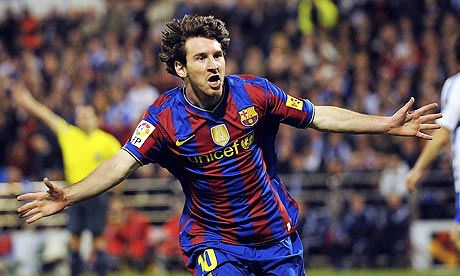
Leo Messi

Leo Messi celebrates after scoring his sensational second goal against Real Zaragoza. Photograph: Denis Doyle/Getty Images

It's not big and it's not clever but sometimes swearing is the only thing that will do. Sometimes you've used up every other word and nothing else quite hits the spot. You've rummaged round the back of the sofa, rifled through the drawers, turned out your pockets and still come up empty. Pep Guardiola insisted that he was clean out of adjectives and frankly so was everyone else. Spain was suffering a severe shortage of superlatives last night. The Catalan newspaper Sport invited readers to send in headlines for what they had just witnessed and there were plenty of super, sensational and sublimes, some magic, magnificent and marvellouses, wows and wonderfuls, plus deities by the dozen, and even a Supercalifragilisticexpialidocious, but still there was no way to really do it justice. No polite way anyway. Just wide eyes, a wider mouth and a simple: holy shit!

What they had witnessed would have been one of the most brilliant performances imaginable from Leo Messi but for one thing: you would never have imagined it. He was unbebloodylievable. The milk. The consecrated bread. The dog's dingly-danglies.

It was a performance that started off well, got better in the middle, and by the end was barely believable. One that left you feeling exhausted just watching it, full of ridiculously good touches. It got better and better and better and when you thought it couldn't get any better it got better again. One that went from Crikey to Bloody Hell to Oh my God to Now, you're really taking the mickey. Only Messi wasn't taking the mickey, he was just playing football – the way he plays football. The way no one else has played football. Maybe ever before.
"I'm not sure he's human," said the Zaragoza playmaker Ander Herrera. "Tonight, I saw Diego Maradona," declared the Real Zaragoza coach José Aurelio Gay, "but at more revs per minute. There are no words left to describe him – he is interplanetary. We could have beaten Barcelona but we could never have beaten Leo Messi. If we had scored four, he would have scored 12."

He didn't get 12, he got three. For his first trick, Messi headed Barcelona into the lead. For his second trick he won the ball near the halfway line, dashed through, the ball never leaving his foot, stepped round three challenges, left Matteo Contini on his backside, and hit a low shot into the net. And for his hat-trick, he curled in a beauty from the edge of the area. Then he produced a bit of barely plausible skill inside the Zaragoza penalty area, flicking over one man and stepping beyond another, before being pulled down for a penalty. It would have been his fourth only he got up, dusted himself off and handed the ball to Zlatan Ibrahimovic instead. "Well," Messi shrugged, "Zlatan needed it."

He certainly did. If Messi has scored the unscoreable, the Swede, who had scored only once this year, had missed the unmissable. No wonder everyone went weak at the knees. He's a genius – and so generous too! He'd done the truly impossible – scored three and made Ibrahimovic score too.

He was, insisted Carles Ruipérez in La Vanguardia, "Unbelievable. Unrivalled. Unrepeatable. Spectacular. Marvellous. Wonderful. Genial. Incredible." "Messi is the God of football," declared Sport. "Stratospheric. Magical. Divine. Generous. Extraordinary." "ET," ran the headline inside, "was born in Rosario and plays in Barcelona." "Brutal," added El Mundo Deportivo. On the inside, they were recalling the famous Ronaldo goal against Compostela – one so insultingly good it had Bobby Robson pacing back and forth on the touchline, head in hands muttering: "I don't believe it! I don't believe it!" and the Compostela players threatening to sue for damages. "Maradona + Ronaldo," ran the equation "= Messi". El País called him "infinity", while El Mundo reserved for him a "place amongst the greatest".

Speaking of the greatest, even Marca, the newspaper who decided to ignore Messi's brilliance against Stuttgart on Wednesday by splashing on the breaking news that Muhammad Ali is a legend, found a place for him on their cover. Near the bottom, but on the cover nonetheless, with the headline "Super Messi". "Maradona, here's your son," it said inside. AS too gave Messi big billing – just above a Rafa van der Vaart explaining that just because he controlled the ball with his hands it doesn't mean he handballed it. "Messi," said the paper, "is from another world!"

All of which might seem a bit over the top for a hat-trick against the side that conceded six against Real Madrid and lie just three points above the relegation zone. Late last night, on the ape-house shouting-fest that is Punto Pelota, Pedro Pablo San Martín turned on his fellow guests, accusing them of "popping Viagra", shouting: "Stop going on about him all the time! It's only Zaragoza!"

Only, it's not. And that is the point. It's not only Zaragoza, it's everyone else too. It's every game. For Barcelona, at least. One of the incredible things about Messi is how rarely he disappoints. In fact, it's tempting to conclude that he has made the ridiculous so routine that he doesn't get talked about as much as deserves; playing perfectly is hardly news. It was not just Zaragoza, it was the fact that Messi has now scored two La Liga hat-tricks in a row, after an astonishingly brilliant three against Valencia last week. It was the fact that, until he handed the ball to Ibrahimovic, he had scored Barcelona's last nine goals. It was the display against Stuttgart that prompted Christian Gross to admit: "Comparing him to Maradona is perfectly licit now." It was the eight in a week. The 11 in five games. The free-kick against Almería – so subtle, so stupidly soft you wonder if he was wearing slippers. And playing with a balloon. The 25 in the league already, the 34 in all competitions.

It's not just the goals either. When it comes to the inevitable and often tedious comparisons with Cristiano Ronaldo, one of the things that is often said about Messi is that he is not as complete. Earlier this season the pro-Real Madrid newspaper Marca asked the man who had just published a glossy, club-sponsored biography of Ronaldo to do a comparison of Ronaldo and Messi in the midst of its campaign to beatify the Portuguese – and get pictures of him with his top off on their cover as often as possible. Surprise, surprise, Ronaldo won. He scored higher than Messi in heading, speed, shooting, leadership, physical condition, and free-kicks and penalties, scoring the same in technique and passing.

It was not a new conclusion. In England too Ronaldo is invariably described as more complete than Messi – stronger, faster, bigger, more athletic. But aren't they all part of the same package, an obsession with physical strength? Isn't that a pretty incomplete reading of complete? Last season Messi scored twice as many Champions League goals with half as many shots. This season, Messi is the league's top scorer with 10 more than Ronaldo, has provided more assists than anyone else (Ronaldo is not in the top 20) and has completed more passes than any other attacker. He hasn't even taken any penalties.

Yes, they were acting like they were on Viagra. But, no, it wasn't just Zaragoza. It is everything Messi has done throughout his career. The 79 goals in 129 games. The two European Cups and three league titles. If he was not already the best player in the world in his first three seasons – 30 goals in 60 games – it's because of injury. Every season, he missed at least 10 matches. But when he played there were special moments. That unbelievable hat-trick against Real Madrid. That Getafe goal. The pair of destructions of Atlético Madrid. The naturalness with which he took over from Ronaldinho – every bit as much the messiah but not such a naughty boy.

You always felt he was just an injury-free season away from being the best. Last season he got it. Last season he got 38. The top scorer's award in the Champions League. The goal in the Champions League final. And the World Club Cup final. And the two in what was effectively the league final – the historic 6-2 against Real Madrid at the Santiago Bernabéu, when he was described as "Maradona, Cruyff, and Best rolled into one". As well as the Copa sublime hat-trick that knocked Atlético out of the Cup and saw the Vicente Calderón hand him a standing ovation.

It is everything Messi has done and how he has done it. It is the sheer stupidness of his talent, the ohmygoddidyoujustseewhathedid? about him. The fact that he gets hacked at and somehow keeps on running, that he'd be like a Weeble only he hardly ever even wobbles. That the ball, to use the old cliché, really does seem to be tied to his feet. He doesn't even seem to kick it most of the time: like a faithful dog, it just runs alongside him. That he's like the kid in the under-10s team that picks the ball up, runs rings round everyone and scores; that he is exactly the kid he was when he was a kid. That he goes from 0-60 in no time and from 60-0 again in even less – what was so stunning about his goal against Valencia last weekend was how suddenly he stopped, sending the defender screeching by like a cartoon character off a cliff.
  
It is that last night his president Joan Laporta announced that Messi is the best player in Barcelona's history – and it didn't sound completely ridiculous. Premature, yes. Exaggerated, probably. But not completely ridiculous. Yes, Messi has more to win in order to prove it – although he has already won more than George Best ever did and more European Cups than Diego Maradona. Yes, he still has to achieve things to make his case watertight, particularly with Argentina. But how could it be otherwise? After all, for all the sublime touches, the goals, the assists and the win-it-on-his-own performances, perhaps the most ridiculous thing of all is that Leo Messi is still only 22.

Sid Lowe  

Wednesday, 10 March 2010

[totalBarca] Ibrahimovic: The Misunderstood Performer


Zlatan Ibrahimovic (28) has been the subject of a lot of heated FC Barcelona fan discussions lately. After being transferred to FC Barcelona from FC Internazionale Milano this season in a swap deal that included Samuel Eto’o (28) and a sum of money as the transfer fee, Ibrahimovic quickly garnered media and fans’ attention.
In the beginning, it was all high for Ibrahimovic as he started with an assist to Messi and being recorded in FC Barcelona’s history as the only player to be able to score in four consecutive opening league games, beating Hristo Stoichkov, the previous record holder. But lately, his form has been dipping and together with it, a slight declining of Barca’s performance. So far, Barca has failed in one competition, the Spanish Cup. Can something be concluded from this situation? Is it really Ibra’s fault? Here is a point of view of some things that have been happening lately.
The recent drop in Barca’s form has caused alarm in a lot of quarters. While it is very easy to quickly point fingers to a culprit, namely and particularly Ibrahimovic, there are a lot of explanations as to why the situation is not as easy and simple as we think, as football is not just twenty-two players, two managers, and spectators. It also includes the bigger picture – the cultural and political situations, especially in Barcelona, poised for a change in directorship and having a distinct culture from the rest of Spain. In the following paragraphs, I will try to give a number of reasons why it may be premature to blame Ibrahimovic and stamp him as a failure and a failed transfer. Of course I won’t go too far as to discuss the cultural repercussions, but here are my reasons.
1. Ibra is purchased by Pep’s decision, backed by the directors, and is seen as a key transfer this season
Pep really wanted this player and looking at the total transfer value that is reportedly nearing the €69 million mark, he has the support of the rest of the team and the board of directors. So if we really regard Ibra (ato Dima) as the purchase that failed, we might just as well say that Pep failed. Now the reason Pep wouldn’t extend his contract as soon as possible is that he had known for sure the pressure is really heavy – he can’t be better than last season because last season was a perfect performance. But fans everywhere state they will support Pep 100%.  So, Pep agreed to a deal that will make him stay until Summer 2011. Now, Barca are in 2nd position in La Liga even though we are short only 26 points to the winning point total of last season with 13 matches left to be played. But things could have gone more awry. Remember the 2006/7 season? Where is the 100% support for Pep that we have promised?
2. Football is a game between two opposing teams
So if we want to critique FC Barcelona, or compare them to other teams, we should also take note of the opponents. Now, is there currently any other team that has to face 8 opposing players constantly positioned in their penalty box every week? Is there any team that has had a perfect season so that every opposing team this season face them with extra enthusiasm and motivation? There hasn’t been any perfect team and probably never will be. History says that there has never been a team that can win the Champions league sequentially since the modern era and this is not without reason. So, Ibra may have been weak lately, but it is totally void to compare him to other strikers right now, as no other team has to deal with bus parking strategies and physical games week in, week out. To bring the case further, is it actually his own fault, or is it simply a result of a specific player’s instruction?
3. Tiki-taka short triangular passes are at maximum efficiency when it’s unpredictable
Now, the problem is that the passes are not that unpredictable anymore. With Barca constantly having more than 60% possession of the ball, nowadays it is more of a norm than an achievement. Their playmaking videos can even be learned and seen on sites like YouTube. Do we fool ourselves by thinking the opponent’s coach and players would do nothing when they have experienced themselves such convincing and humiliating defeats last season? They must be really motivated to counter that style of football, to take the game back into their own hands. And unconsciously, collectively, they seem to have found the most powerful way to prevent it: Rubin Kazan tactics. That can be summed up as “bus parking,” fast and powerful counter attack, and a physical game. And indeed, in every strategy there must be gaps and weaknesses, for no football tactic is perfect.
Look for Xavi and Iniesta now and how the defenders and the midfielders are more clever in jostling them, rarely chasing the ball, only limiting Xavi’s and Iniesta’s options by collectively hounding them. And also lately, Ibra seems to be instructed by Pep to be tactically closer to the goal, so he rarely has much space. Meanwhile, previous strikers like Eto’o were often instructed to spread to the flanks to create goal scoring opportunities. Why is that so?
4. Pep hasn’t found a comprehensive strategy to solve this season’s situations yet

I think there are two strategies that can be used as an approach in winning a football match:

a) Using the same strategy, formation, and tactics to attain the much coveted perfection level and usually goals depend on the individual improvisation and processes similar to one another. The victory is usually obtained from individual telepathic playing style because each player have known each other’s playing style to such an extent, or a collective skill advantage.

b) Using formations and strategies that continue to vary depending on the opposition. Victory is usually obtained from a tactical advantage or a moment of brilliance from the team star.


From the above 2 approaches, Alex Ferguson, Capello, and Lippi clearly adheres to the (b) approach. While, Rijkaard and Ancelotti is closer to the (a) approach. No approach is strictly better than the other. And generally if a coach is closer to the (a) approach, usually they are very close to the players and the players are more prominent than the coach, while coaches that adheres to the approach (b), usually are stricter as any star can be thrown out and relegated to the sidelines should he fail to obey the plan. The relationship between the coach and players is usually very professional.
What about our current coach, Pep Guardiola? Last season, I think Pep embraced the (a) approach for regular games, but using (b) for big matches (i.e. the final against Manchester United, Messi is posed as a ‘No.9′ striker, and Barca finally won the game with Messi scoring an unmarked solid header). This season, Pep seemed to mostly use the (b) approach in fear that his team would have stagnated like in the 2006/2007 season.
Therefore, this season Pep is looking for a striker that, according to him can give Barca new tactical options. He proceeded with some tactical experiments immediately after the season began. Of course, some experimentation was successful (Club World Cup 2009, which Rijkaard failed to win in 2006), while some are less than satisfactory (the last couple of games, and especially the draw against Almeria yesterday). So is it purely Ibra’s mistake? It doesn’t seem so.
5. Putting Ibra alone inside the penalty box with 4 or more defenders marking him isn’t exactly the best way to win matches
These past few games, this is exactly what has happened in the beginning 60 minutes of the match. Especially with Pedro on the right and Iniesta on the left wing, the wingers do not go into the penalty box WITHOUT the ball but had to go into the box WITH the ball, making Barca’s game pattern easily read by the opposition.
Combine that with Messi playing as a playmaker in the center attacking midfielder position, and it will be clear why Xavi, Ibra, and the rest of team seemed to play way below their full potential. Xavi’s game was not developed because he is too far away from Iniesta and often assigned to drop deep, feed the ball to the flanks and only as a connector between the backline and midfield. Xavi will unlock his full capabilities when he can also make plays in the final third of the pitch (as shown in the match against Malaga after Barcelona returns to their normal strategy).
In Ibra’s case it became particularly difficult for him to improve his performance when there are no other players that can disrupt the defenders’ concentration and who can become his partner in a one-two pass inside the penalty box. In the game against Almeria yesterday, there was one moment where Ibra was able to cut inside from the left wing and it is puzzling why he didn’t attempt it more often. It could be that Pep doesn’t want too much player position changes in his experimental strategies. This all shows that a striker in this modern era, however good he is, when alone in the penalty box and isolated from the rest of his team, will rarely make a contribution.
6. Ibra is a performer at heart
So relegating him to a post man striker who just waits for the ball and provides physical presence in the penalty box may not be in the team’s best interest, although the reason Pep is trying him as that kind of player on the pitch might just be to see how predatory he is in front of the goal. It is known that he converted to his current striker position from the influence of Fabio Capello when Ibra first arrived in Juventus. Capello wanted to mold him as a Van Basten-type striker. So he may have been a more attacking midfield type, instead he has not participated in the conversion. So, maybe rather than just Ibra adapting to Pep and Barcelona’s play style, it may also be the case that Pep is trying a different style of play that can maximize the potential of the entire team, including Ibra. Unfortunately, that balance has not been found.

Based on the above reasons, I think a fresh perspective in dealing with the current performance of FC Barcelona and the player that is used by many fans as their scapegoat, Zlatan Ibrahimovic, can be offered. And as always, Visca Barcelona, and please give us your comments. Thank you for reading.

Tuesday, 9 March 2010

[totalBarca] Ten reasons to believe in this Barça


There is no reason for alarm or anxiety.  The data and the facts show that this Barcelona still has tremendous credibility and to lose faith in a team that has won it all would be as unjust as it is unfortunate.  To support the faith of the fans, Catalán news site Sport presented a list of ten reasons to believe in FC Barcelona.

1. They have played 41 matches this season and only lost three.
A team that wins 73% of the games that it plays and has only lost 3 of the 41 it has disputed deserves all the credit in the world.  Its regularity is one of its principal credentials to aspire to all titles.  Real Madrid has seven games less and has lost twice the encounters.

2. They have earned two more points in the League by week 25 than last year.
It might be that they don’t show the superiority of last season, but their effectiveness is better. Last year by this week they had earned 60 points and suffered two consecutive defeats (Espanyol  and Atlético), while now they have earned 62.

3.  A great defensive solidarity has left 13 matches with zero goals allowed.
Victor Valdés and his defense have improved the numbers from last season.  They have accumulated 13  matches out of 25 with zero goals against.  That is to say, Barça has not allowed a goal in over half of their encounters in the League.

4. They have not scored in only three matches, none of which they lost.
This Barcelona might not be the goal-scoring machine of last season, but they are displaying an offensive power that is simply uncommon.   Of the 41 matches of this season, they have scored in all, except in the League against Valencia in Mestalla (0-0), and in the Champions League matches against Inter in the  Giuseppe Meazza (0-0) and against Rubin Kazan in Russia (0-0).  In addition, Messi is the current pichichi of the League with 19 goals.  In short, Barça has scored 89 goals in 41 games, or more than two per encounter.

5. The ‘FIFA virus’ has not affected them this season.
The ‘Pep Team’ traditionally has been affected more than others by their international players leaving for their respective matches.  In fact, after the four occasions that they have had to go, Barça has won once and drawn three times (Valencia, Athletic de Bilbao and Almería). Fortunately, there are no more international matches to be played until after the end of the season.

6. They have a defined style and are betting on the cantera.
Madrid would like to be able to say  that they count on a style that everyone wants to imitate and with a team based almost entirely on home-grown players. However, this is only true for Barcelona. Barça defends a style that counts on attacking play and always wanting the ball.  And they execute it with  eight of their own canteranos: Valdés, Puyol, Piqué, Sergio Busquets, Xavi, Iniesta, Messi and Pedro.

7. The best Ibrahimovic has yet to appear.
Sooner or later, the Zlatan that left his footprint in Calcio, being named the best player in Italy and ‘Pichichi,’ will appear.  For now, he has only been decisive in the clásico against Madrid.

8.  On the most important occasions, they always show their pride.
If there is something that stands out about this Barça, apart from their footballing identity, it is that they have never failed to play for pride.  One just has to look at the elimination in the Copa del Rey against Sevilla, where the team said goodbye by winning 1-0 in the Sánchez Pizjuán and gave a grand performance.

9. Two key pieces return: Keita and Abidal.
Keita should be available against Valencia or later against Stuttgart.  Meanwhile, Abidal will have to wait only two more weeks.

10. They depend on themselves, despite a battle against the best Madrid of the decade.
In the capital, they are already labeling them as the best Real Madrid of the decade.  Well okay, Barça is tied in the League with this Madrid, who is only the virtual leader, and a tie in the Bernabéu would give the leadership to the blaugrana.