Wednesday, 21 December 2011

A guy who was in the stands of the 1-3 El Clásico shares a story he happened to witness:

In fact, there was a moment in the 2nd half, near the end, when Puyol when to the sideline and said to Pep that he was so tired and could use a substitution. Pep, from the sideline, told him he would hold until the end of the match in a very catalan expression (literally translating to "by my balls you end the match". In catalan doesn't sound so bold, mind you). So Puyol had to endure the last 10 minutes.

Monday, 19 December 2011

Ce mă freacă lăbăreala din ziare.

De fiecare dată când Barcelona reuşeşte ceva interesant (slavă nu-ştiu-cui, ultima vreme s-a întâmplat des!) intru pe toate ziarele să văd comparativ modul de prezentare şi impresia lăsată. Presa e ridicolă. Dar mai tare decât cele aservite Barcelonei, care fie că echipa joacă bine, fie rău - au numai titluri gen "magnific, superb, regi" bla-bla sunt cele aservite Madridului. Care, spaniole fiind TREBUIE să raporteze destul de detaliat succesul rivalei, însă totodată TREBUIE să menţină Realul într-un mod pozitiv pe prima copertă. Preferabil ca Lideres.

La succesele europene am observat, totuşi, că pe măsură ce echipa lui Guardiola a câştigat mai multe trofee şi ei prezintă mai pozitiv succesul. Ca şi cum - da, stim că sunt tari, noi spaniolii suntem tari - spre deosebire de titlurile vechi gen controversă la succesul Barcelonei. E adevărat, schimbarea a fist accentuată logaritmic după succesul Spaniei la CM.

În disputele cu Madrid iarăşi am observat că faţă de acum câţiva ani (când un 6-2 sau titlu intern câştigat era privit ca bulănos şi cu ciudă) acum tonul este mai degrabă critic la adresa Madridului, lui Ronaldo şi chiar Mourinho. Barcelona în schimb este privită cu oarecare simpatie, mângâiată cu epitete gen "meritat, sunt mai buni" - nici pe ultima controversă cu rosu-ul lui Messi nebătându-se prea mult toaca. Un fel de "da, merita roşu, dar asta tot nu scuză că noi aveam 1-0, 9 puncte şi nu am jucat nimic. Dacă nu acum, atunci când?"

Mai demult de la un insucces cu Barcelona treceau 2 zile (adică O copertă în care Barça să fie prezentată bulănos) până iarăşi pe copertă apărea o poză sexy cu Benzema, Ronaldo sau Kaka anunţând "glorie" în viitor şi cât de buni sunt ei de fapt. Chestii normale dacă vrei să-ţi lingi rănile, dar care arată destul de LAME. Acum e... diferit.

Însă pentru suportul (moral) al echipei şi al fanilor descumpăniţi de încă un insucces cu Barcelona e nevoie şi să priveşti statisticile diferit, să cauţi un semn bun. Care - în lumea statisticilor e întotdeauna greu de găsit. 

Astfel, dacă titlul din 2011 a fost pierdut şi cel din 2012 are şi el şanse să fie la fel Realul se mângâie. In anul CALENDARISTIC 2011 ei au câştigat Liga, obţinând cu 3 puncte mai mult ca Barcelona. Chestie de moral. Mie ca fan al Madridului energie mi-ar da faptul că pur şi simplu echipa asta NU pierde cu echipele mici, le rupe - nu că "tehnic în 2011 am scos mai multe puncte" - pentru că acolo sunt multe steluţe. Poate (nu îmi amintesc) ăia aveau 3-5 puncte avans la intrarea în ianuarie, poate au câştigat anticipat campionatul şi şi-au băgat juniorii, etc.
La fel cum aş fi mândru de Ronaldo că e jucător bun şi dă goluri, dar nu neapărat să consider faptul că Pichichi-ul e DOVADA acestui fapt. Odată ce titlul era matematic la rivali îmi amintesc un Ronaldo care a dat vreo 10 goluri în 3 sau 4 meciuri, când Messi nu mai jucase deloc fiind înainte de finala Ligii. Pe lângă că oricum un seyon mai bun ca al adversarului nu spune neapărat că eşti mai bun, datorită asemenor tehnicalităţi e al dracului de greu şi să faci o statistică faţă-în-faţă.

Dar articolul cu "Realul, campioana anului 2011" îşi avea locul frumos pe prima pagină a site-ului Marca. În stânga în schimb era "Santos - Barcelona 0-4. Barcelona, Regi." lucru care ca suporter m-ar face să mă ruşinez. Ştiu că sunt defazat fiind fan Barcelona, doar că am pretenţia de puţină obiectivitate când spun că dacă Realul ne-ar fi scos în semifinale cu victorie pe Camp Nou, ar fi câştigat Liga Campionilor şi apoi şi-ar fi câştigat biletele la Campionatul Mondial Al Cluburilor unde ar fi înregistrat cel mai bun parcurs din istoria competiţiei, împotriva unei echipe de la care vine marea mea speranţă pentru detronarea lor (redus la anonimitate de jocul adversarilor şi  al unui moşuleţ de 33 de ani care tocmai mi-a anulat superstarul cu 8 zile n urmă LA mine acasă În timp ce aveam 9 puncte virtuale în faţa lor în campionat) nu m-ar fi prea încălzit o victorie cu 6 goluri împotriva Sevillei sau faptul că "tehnic" suntem campionii anului.

Iar ca dovadă am faptul că mi-a fost rece în 2003-2004 când Barcelona, la primul an al lui Rijkaard a reuşit cel mai tare retur de campionat din istoria sa, cu vreo 15 victorii consecutive printre care şi una pe Santiago Bernabeu. Păcat că terminase turul sezonului cu 12 puncte în spatele Realului. Valencia avea să ia titlul acela, oricum. Dat fiind turul sezonului 2004-2005 (primul cu Eto'o, victorie cu 3-0 în El Clasico, lideri detaşaţi) aş putea fi şi eu mândru că am fost campionii morali ai anului 2004. Doar că... primul titlu de când sunt eu fan Barcelona avea să vină tot în vara 2005, iar 2004 avea să rămână doar "anul în care Ronaldinho a stopat sentimentul meu de impotenţă cu Realul". Lucrur pe care Ronaldo nu l-a prea reuşit încă. Încă.

Trebuie să fiu sincer. Da, Realul arată bine (ok - nu arată deloc rău vreau să zic), dar - DA, mă bucur că nu sunt fan al lor pentru că mie îmi pare că m-aş fi simţit umilit prea des. Şi cu siguranţă nu aş fi lăsat Marca să-mi lingă rănile. La unii o merge mici semne că totuşi suntem buni, dar la mine nu. Nu declaraţii bombastice după care să facă mişto în caricaturi îia din Sport sau EMD... doar jocul poate să mă convingă. Şi - revin - îmi plăcea jocul Barcelonei chiar fără trofee de cand mă uit la fotbal. Nu credeam să ajungă clubul vreodată aşa dominant, cu atât de mult succes şi stil. Cel mai tare (dintre oponenţii pe teren) mi-ar fi plăcut să fiu jucător la Santos. Ăia aveau aşteptări dar se aşteptau şi să o muşte. Mi-ar fi plăcut să mă recunosc învins şi să strâng mâna Barcelonei de pe teren.

Mi-o atras atenţia unu' că Nenea Neymar, pe cat de fiţos şi crestos se zice că e (şi poate e), e dus puţin în inaginea aia şi de presă/Péle pentru că dacă citeşti doar replicile lui din interviuri pare destul de modest. Iar ieri a fost.

Paralela


Mică şi superficială paralelă a coincidenţelor şi complexelor între Manchester City şi City-ul Madrilen. Cu steluţă.

vara 2008.
City (Madrid) primeşte o infuzie de bani şi anunţă că vrea gloria. Şef (preşedinte) nou, încep transferurile bombă.

2008-2009
Rivala, United (Barcelona), ia titlul cu câteva etape înainte de final şi ajunge în finală (câştigă) UEFA Champions League.

2009-2010
Mai mulţi bani băgaţi, iarăşi niciun trofeu, pentru City (Madrid) sau United (steluţa - Barcelona ia titlul)

2010-2011
United (Barcelona) ia titlul cu câteva etape înainte de final şi ajunge în finala (câştigă) Champions League. Dar City (Madrid) reuşeşte să stopeze seceta câştigând Cupa învingând surprinzător United-ul (Barcelona) cu 1-0 în semifinală (finală). Bla-bla, dovadă că până la urmă banii investiţi nu au fost în van, urmează lucruri mari, etc.

2011-2012
Un City (Madrid) readus la viaţă de către trofeul proaspăt câştigat dispută Supercupa cu Marele Rival, United (Barcelona) dar deşi aşteptările sunt mari, pierde trofeul - cu lupii bătrâni nu te pui.
În campionat, spre finalul turului, City (Madrid) pare mult mai stabilită, conducând cu 2 (3) puncte în faţa lui United (Barcelona) şi având multe rezultate-bombă de genul un_număr_mult_mai_mare_de_3-1. Datorită costanţei în campionat şi în ciuda United-ului (Barcelonei) aflate aproape, City (Madrid) rămâne totuşi favorită la titlu.

Friday, 16 December 2011

SAN - BCN

From Neymar-Messi to Pelé-Cruijff

June 1959

July 1960

June 1963

September 1974

August 1998
December 2011


[pies] Spot Steaua Bucharest’s Little Tifo Choreography Error?

So close…


edit: unii zic ca 9-le e intentionat intors pentru a marca a noua calificare in primavara europeana. Poate, dar cred ca daca asa e era mai simplu sa il faca mai vizibil

[Jonathan Wilson] The Question: just how competitive is the Premier League?

Based on a study of world leagues, it may be that England's top flight is not the fierce contest its branding suggests
• To read part two of this series, click here
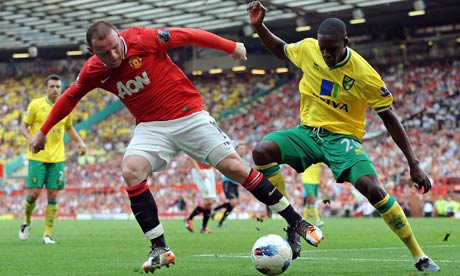
Premier League: Manchester United v Norwich City
Norwich impressed at Old Trafford and showed the kind of spirit that is a Premier League selling point. They lost 2-0, however.

It's the most competitive league in the world. Anybody can beat anybody on their day. There are no easy games in this league. The mantra of the Premier League apologists is well known. Every time a team from the Little Fourteen (as nobody ever calls them) plays a team from the Big Three (it is just three now, right?) the cliches come trotting along: in our league nobody gives anybody anything, everything's a glorious struggle.

It's nonsense, of course: it's obvious the Premier League is a closed shop that can be opened only with the application of around a quarter of a billion pounds. In England in the past decade there have been three different champions. That's the same as Spain, Italy and Portugal, poorer than France (four), and Germany and Russia (five). But then in the past decade there have been Champions League winners from England, Spain, Italy and Portugal, and not from France, Germany or Russia. It seems fairly obvious that competitiveness is something that must be balanced against quality: would fans prefer an exciting domestic league, or for teams from that league to do well in continental competition?

That's not to say that a low number of different champions is necessarily a sign of strength or high quality. In Croatia, Dinamo Zagreb have won the league for the past six seasons and made next to no impression in Europe. The problem, Igor Biscan said, is that their players get used to winning easily; come a tough match, a game against a side of even slightly lesser ability, in which they have to do things that don't come naturally, like defending, they have no idea what to do. "Our players walk through games against villages so they forget how to run," as a Crvena Zvezda director put it to me a couple of years ago. "But what are we meant to do? Buy players for the other teams in the league as well?"

Rangers and Celtic have perhaps suffered from that at times in Europe, which may mean that the domination of European football by Barcelona and Real Madrid many have predicted is not quite so sustainable as many think. That in turn is something to consider for those who would tweak the balance of competition in the Premier League by doing away with collective bargaining for TV rights (quite apart from asking whether the product will remain so appealing if games are hideously one-sided). That answer to the Zvezda official's question, in fact, may end up being "yes", if only indirectly.

If you want a true range of champions, you need to leave Europe. There have been six different champions in Japan in the past decade, seven in Brazil. In Argentina, where the apertura-clausura system means there have been 20 championships in the past decade, there have been 11 different winners – but there the spread of champions seems a function of weakness, with the best players from the best sides being skimmed off by predators from Europe and Brazil after each championship in what's effectively a reverse of the draft system in US sports.

But even if we accept competitiveness per se as a good thing, there are different types of competitiveness. After all, while there have been five different champions in the past decade in Germany, Bayern Munich have won the title five times, the same number as Manchester United, Barcelona and Internazionale (Porto and Lyon, incidentally, are the most successful individual clubs in the 10 leagues considered with seven titles each in the past decade). In effect, in Germany there is a Big One and, if they fire, nobody else has much of a chance. Whether one giant and a handful of occasional challengers is preferable to two or three giants is debatable.

Looking at the number of champions, though, says little about whether a team at the bottom can beat a team at the top. To try to come up with a statistical basis for assessing competitiveness within a league, I looked at four metrics across the 10 leagues (England, Spain, Italy, Germany, France, Portugal, Russia, Brazil, Argentina and Japan) over the past decade: the average gap from first to second at the end of the season (how dominant is the champion?); the average gap from first to fourth (is it only two or three teams who challenge the champion?); the average gap from first to last (what's the gulf in quality from top to bottom?); and the average gap from fourth to fourth-bottom (what's the difference in quality between the mid-ranking sides?). Because different leagues have different formats and are different sizes, these gaps have all been expressed as points-per-game. (Points deductions were ignored). 

Team
1st-2nd
1st-4th
1st-last
4th-4th last
England 0.17 0.52 1.92 0.79
Spain 0.14 0.5 1.42 0.62
Italy 0.19 0.53 1.66 0.68
Germany 0.2 0.4 1.4 0.71
France 0.19 0.42 1.3 0.54
Portugal 0.27 0.72 1.68 0.64
Russia 0.11 0.34 1.49 0.68
Brazil 0.17 0.33 1.18 0.56
Argentina 0.17 0.46 1.5 0.7
Japan 0.19 0.36 1.39 0.62

In terms of exciting title races, it turns out that Russia is the place to be, with Spain some way back, and the rest trailing far behind. Perhaps not surprisingly, given Porto's domination, Portugal has the highest gap from first to second, but what is striking is that Germany has had the second-least-close title races over the past decade, a fifth of a point-per-game separating first from second. The gap between first and fourth in the Bundesliga, though, is the fourth smallest of the 10 leagues surveyed, the gap from top to bottom the third smallest and the gap from fourth to fourth-bottom the smallest. That suggests that the leader often streaks away while the rest remain relatively tightly bunched.

The biggest gap from first to fourth is in Portugal. Again, that's in line with expectations: since the second world war, only Belenenses and Boavista, once each, have interrupted the flow of titles for Porto, Benfica and Sporting. There is a very clear historical Big Three who continue to dominate. In Italy, similarly, the two Milan clubs and Juventus (calciopoli notwithstanding) have clearly been dominant. What is perhaps unexpected, though, is that England have the third-biggest average gap from first to fourth: perhaps the Big Four was always something of a myth.

Brazil has the smallest gap from first to fourth, which it is tempting to ascribe to the size of the country. A population of almost 200 million can perhaps sustain more big clubs that smaller nations. It is also worth noting, though, the relative immaturity of a national championship in Brazil; it could be that as the present system becomes more established, money and success gravitates to a more select few.

But what's really telling is the last two columns, which show that there is a bigger gap between top and bottom of the Premier League and between fourth and fourth bottom in the Premier League than in any of the other nine leagues under consideration. Far from being the most competitive league in the world, in fact, it turns out to be the least. The league where the bottom is closest to the top, rather, is Brazil, which is remarkable when you consider that the statistics include the 28-team top flight of 2001 and the slow contraction to 20 in 2006 – the more teams there are, the wider you would expect that divide to be.

Now of course an analysis of points tells only part of the story. It may be, in some hard-to-quantify way, that lower Premier League teams fight harder before losing to the big guns, and it certainly is true that the culture of arranged games, mutually beneficial draws and the like, seems less pronounced in England than elsewhere.

In terms of hard statistics, though, the message is clear. The Premier League may lead the way in terms of marketing and self-promotion, but if you want competitiveness, go to Russia or Brazil.

Next week, I'll look at how competitiveness has changed in England over time, what the reasons for those changes may be and what the potential impact of scrapping collective bargaining for television rights may be.

[guardian.co.uk] The Question: Is the 3-1-4-2 formation on the rise?


Something very odd happened at the end of last week. Historical changes in tactics usually happen incrementally over time: there would be rumours of a side doing something unusual ("and they say the centre-forward plays in midfield …") followed by a pivotal game in which that tactical change proves decisive and is accepted as a new phase in football's development (Nandor Hidegkuti picks England apart while scoring three in Hungary's 6-3 win at Wembley in 1953).

More recently, perhaps, with the blanket televisation of football, it's been possible to trace the evolution, but still, there tends to be one moment, one game in which everything snaps into focus (Lionel Messi, for instance, ripping Real Madrid apart from the false nine position)

As has now been well-documented, El Clásico turned on Pep Guardiola's decision midway through the first half to abandon the slightly odd 4-3-Cesc Fábregas-2 with which he had begun. He pushed Dani Alves from right-back to right midfield, so he could check the runs of Marcelo and cut off the support for Cristiano Ronaldo, a move that also spared him from having to pretend he is a full-back which, as anybody who has seen him play for Brazil will know, he is not.

That meant Carles Puyol moving to right-back, with Sergio Busquets dropping in to become a second centre-back. Gerard Piqué became the right-sided centre-back, allowing him to double up on Ronaldo when required, while Alexis Sánchez moved to become a highly mobile centre-forward (a false nine, if you like, but with lateral rather than longitudinal movement). Messi operated as an orthodox 10, with Andrés Iniesta shuttling on the left and Fábregas brought back much closer to Xavi Hernández. At first, the formation looked like a highly fluent 4-2-3-1, as though Barça were going to match Real Madrid shape for shape, but then the real benefit of the system became clear.

It is often overlooked just how key Busquets is to initiating Barça attacks, but he is always there as the get-out: if a player gets into trouble, he can go back to Busquets. Block off the escape route, though, and anxiety can be induced. Attack the metronome and the whole orchestra loses rhythm. José Mourinho surprised many by opting for a 4-2-3-1 rather than a 4-3-3, but what it allowed him to do was press with five men, leaving Lassana Diarra to protect the back four. That brought the opening goal, but it also rattled Barça.

Moving Busquets back, though, gave him time and space. Withdrawn from the front line, he could begin again to shape the battle. It was a risk, because it left Mesut Ozil free, but he is a slightly old-fashioned playmaker, somebody who is adept at finding time amid the hubbub to measure a pass. Usually that is an asset, but here it gave Busquets time to close him down. We are used to seeing Busquets dropping back from midfield to become a centre-back; but here he was doing the opposite, stepping out from the back four to become a midfielder. Perhaps this is the logical outcome for a side that flips so often between a back three and a back four: it ends up playing a back three-and-a-half.

First principles

But there is a deeper logic, and one that could be predicted [see the article about "is the sweeper coming back?]. When Jack Charlton made his famous comment after the 1994 World Cup about full-backs being the most important position on the field, he was specifically referring to the fact that when two 4-4-2s clash, the full-backs are the players with a direct opponent. They are special not because of anything inherent in being a full-back, but because they are the players with the time and space to shape the game.

Football has moved on, though, and the prevalence of 4-2-3-1 and 4-3-3 means that full-backs often do have a direct opponent. That can create fascinating tactical duels – Roberto Carlos v David Beckham as Real Madrid beat Manchester United 3-1 in 2003, Theo Walcott v Danijel Pranjic as England won 4-1 in Croatia in 2008, Michael Essien v Cristiano Ronaldo in the Champions League final in 2008, Gareth Bale v Maicon as Tottenham beat Internazionale last season – but it also means that the space that was once the full-back's birthright is no longer guaranteed.

So where is that space? If a team plays a back four against an opponent with a lone central striker (or a false nine), then at least one of its centre-backs should be spare. It's not quite the same as a full-back being free in that it's clearly far easier for a single striker to shuffle 10 yards to close down the other centre-back than it is for him to run 30 yards to close down a full-back, but two centre-backs faced with one forward trying to close them down should be able to work space for one of them to step forward with the ball, at least until a potential presser from the opposing midfield comes into play.

Two years ago, I suggested we would increasingly see Piqué start to step forward with the ball to join Busquets in midfield; actually the reverse has happened and we have seen Busquets drop back to join Piqué (the clue was in the influence of Bielsa on Guardiola; the Argentinian visionary, also an inspiration for Universidad de Chile's coach Jorge Sampaoli, has a habit of pulling midfielders back into defence, as he has done with Javi Martínez at Athletic Bilbao). The effect is the same, a central defender who steps out from the back, a playmaker from the centre of defence.

An environment of change

And that is what makes Busquets's role so fascinating – it facilitates a back three-and-a-half in a system that presses. Again, there is a precedent, and perhaps it is not surprising that it should be found in the heritage of this Barça: Johan Cruyff's Barcelona Dream Team of the early 90s, although they also lined up in a 4-3-3 or a 4-4-2, often played a 3-1-3-3, as did the Holland of Guus Hiddink. In Cruyff's variant, Ronaldo Koeman was often the one, although Guardiola himself operated there on occasions; but at Euro 96 Hiddink was playing Clarence Seedorf in the role.

So Guardiola, to an extent, has gone back to his roots, although there is a difference between the roles of Koeman and Busquets, if only in how opponents line up against them. Where Cruyff's 3-1-3-3 was rooted in the Rinus Michels belief that you played as many defenders as the opponent had forwards, plus one, and so Koeman was effectively free until there was an attack down the flank at which he had to drop back to become a second centre-back, Guardiola's – on Saturday at least – was predicated on Busquets staying deep (like Koeman deeper than the opposition midfield, but actually deeper than Koeman because the general trend from three-band to four-band systems means the first wave of opposing midfield tends to play higher) and stepping up when the opposing playmaker came into the game.

And that brings us to the other recent sighting of the back three-and-a-half, which was in the Spanish Super Cup. Applying first principles to the issue of tackling a false nine, it makes sense to play a back three and track the opposing false nine with the player who would have been the second centre-back, whether a defender or a holding midfielder. That was precisely how Mourinho deployed Ricardo Carvalho against Messi, with some success, even if the result ended up going against Real Madrid – again, the result being a back three with a player who often played in the back line but did not remain there.

So that gives us four examples this season, of teams playing a 3-1-4-2. All had different motivations. For Real Madrid, it was to free a player to man-mark. For Universidad de Chile, it was to provide the cover that allowed the wing-backs to engage Liga de Quito's wing-backs high up the pitch. For Rwanda it was to wrest control of the midfield through weight of numbers in the centre. For Barcelona it was to create space for their conductor. If there are four separate routes to a single solution, that suggests there is not a sole cause.

So, why now? It comes back, as tactics always do, to space. The prevalence of systems with one or no central strikers means that for much of the last decade, one of the centre-backs has been spare. To an extent, that's quite useful in itself, providing additional defensive cover. But there are more interesting things that can be done with him, and it is that that football is only just beginning to explore.