2001: E3 Barcelona - Liverpool 0-0
2002: E1 Barcelona - Real Madrid 0-2
2006: E1 Barcelona - Milan 0-0 (Second Leg; Qualification)
2008: E1 Barcelona - Manchester United 0-0
2009: E1 Barcelona - Chelsea 0-0
2010: E1 Barcelona - Internazionale 1-0 (Second Leg; Failure)
2011: E1 Barcelona - Real Madrid 1-1 (Second Leg; Qualification)
2012: E1 Barcelona - Chelsea 2-2 (Second Leg; Failure)
2013: E1 Barcelona - Bayern Munchen 0-3 (Second Leg; Failure)
P W D L GF GA GD
9 1 6 2 4 8 -4
Away:
2001: E3 @ Liverpool 0-1 (Second Leg; Failure)
2002: E1 @ Real Madrid 1-1 (Second Leg; Failure)
2006: E1 @ Milan 1-0
2008: E1 @ Manchester United 0-1 (Second Leg; Failure)
2009: E1 @ Chelsea 1-1 (Second Leg; Qualification)
2010: E1 @ Internazionale 1-3
2011: E1 @ Real Madrid 2-0
2012: E1 @ Chelsea 0-1
2013: E1 @ Bayern Munchen 0-4
P W D L GF GA GD
9 2 2 5 6 12 -6
Total:
P W D L GF GA GD QF QFSLH QFSLA
9 1 6 2 4 8 -4 3/9 2/5 1/4

Thursday, 16 May 2013
J. Wilson: Will the football world now follow Bayern's method rather than Barça's?
Tiki-taka is not dead but Tuesday's game showed the centre of New Total Football has moved from Barcelona to Munich
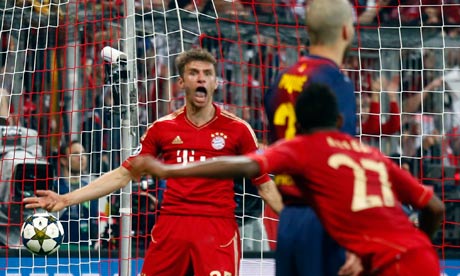
The sun has set on the age of Barcelona and dawn has broken on the bright new age of Bayern Munich. Bayern's demolition of Barça last night certainly had the sense of a game that changed the order of things – even in advance it felt like an era-defining game. It crystallised the sense that Barça are not quite what they were, a weary shadow of the team that won the Champions League in 2011, and that Bayern are rising, inspired by a crop of fine young players and German economic might.
As such the victory – aside for all but ensuring Bayern's place in the Champions League
final – has largely symbolic value. That was the moment, historians
will say (assuming things pan out as we think they will) when the crown
was passed on. Except, of course, that it's not that simple, not least
because eras are no longer so easy to define as they used to be. Look
down the list of European Cup winners and there are reasonably clear
divisions: the age of Real Madrid separated from the era of Catenaccio
and Milanese domination by the Benfica interregnum, the total
footballing time of Ajax and Bayern Munich, then the period of English
domination that was ended at Heysel. That led to a period of flux before
the arrival of Arrigo Sacchi's Milan.
Since the Champions League
began, though, no side has retained the title, let alone won three in a
row. More good teams are involved and the way money is distributed has
led to the creation of a self-perpetuating elite of perhaps half a dozen
sides with a changing group of perhaps half a dozen more (themselves
drawn from a pool of probably 10-15 teams with the very occasional
outlier) challenging them each season. That in turn has brought more
competitive, perhaps even better, games in the later stages of the
competition, which has made it harder for even the very best to sustain
success. Previously the elite could afford an off-day against a lesser
opponent; now there are fewer lesser opponents in the knockout stage and
the slightest slip can mean elimination.
The Champions League
began with Italian domination as Milan and Juventus each reached three
finals in a row, but each won only one of them. Real Madrid then won
three Champions Leagues in five years before the balance shifted to the
Premier League, which produced seven finalists (although only three
winners) between 2005 and 2012, and Barcelona (the two eras,
confusingly, running for a time in parallel).
Few would dispute
that Barcelona has been Europe's leading club over the past half-decade,
and the achievement of reaching six successive semi-finals speaks of a
great consistency of quality. Yet they have won only two of them: they
were squeezed out by Manchester United in 2008 and were the victims of extraordinary defensive performances from Internazionale in 2010 and Chelsea last year.
History will wonder how a side widely – and rightly – hailed as one of
the greatest there has ever been, won only two Champions Leagues.
Of
course next year, such a reflection could seem hideously premature. It
may be that, hopefully fully recovered from cancer, Tito Vilanova, can
next season re-energise this side, can restore the spark and the
invention whose absence meant that, despite dominating possession last
night, Barça rarely looked like scoring. Perhaps he can even teach them
how to repel set plays or persuade the board to sign a defender who can
defend. This, after all, is not an old team; although Carles Puyol is 35
and Xavi 33 none of the other regular outfielders is over 30.
There
was a sense of staleness about Barcelona last night, something that
perhaps explains the over-reliance on Lionel Messi. The great Hungarian
coach Bela Guttmann, of course, believed no side could endure more than three years without major changes and the danger of familiarity was something of which Pep Guardiola seemed acutely conscious without ever being able to combat it.
Part
of the problem has been that so few of the players Barcelona have
signed, outsiders who weren't developed at La Masia (and even one who
was) have truly integrated: Zlatan Ibrahimovic, Alexis Sánchez, Cesc
Fábregas, Dmytro Chyhrynskyi, Alex Song, even David Villa to an extent
(although his broken leg perhaps provides some mitigation), have been a
disappointment, and that has severely compromised the process of
transition.
Almost more than trophies – although there were plenty
of them under Guardiola – what defined the years of Barcelona's
dominance was their style. Others may not have been able to ape
tiki-taka precisely, but there are very few top sides now who don't look to dominate possession and press the opponent high up the pitch.
To
suggest, as some have done, that Bayern's victory somehow ends
tiki-taka is ludicrous. Their style is itself based on similar
principles, on control of possession and winning the ball back high up
the pitch – themselves core tenets of Total Football, which has
underpinned Barcelona's football since Rinus Michels moved there from
Ajax in 1971.
The German variant of the philosophy, which eschewed
pressing, underpinned the successes of Bayern and Borussia
Mönchengladbach in the seventies. The two came together as Jupp
Heynckes, who played for Gladbach, succeeded Louis van Gaal, who had
taken his modernised version of Total Football from Ajax to Barcelona in
1997, at Bayern two years ago.
Only Barcelona have higher
possession stats and have completed a higher percentage of passes than
Bayern in Europe's top five leagues this season. That Bayern last night
achieved only 37% possession is because they modified – or were forced
to modify – their approach against the only side better than them at
holding the ball in Europe. The core philosophy of both is the same.
Bayern
are perhaps a little more physical and a little more direct than Barça
but there is a reason they have appointed Guardiola as their manager
next season. The era of the New Total Football continues, it's just that
its centre has moved from Barcelona to Munich.
Jonathan Wilson: Mourinho exit strategy getting messy
"Have you considered resigning?"
"I have considered staying."
Jose Mourinho said little but said it all. Perhaps the most eloquent comment on his time at Real Madrid in general, and on the way it is drawing to a close in particular, was made during a press conference this week when he said he might stay ... and said it as a threat.
Make no mistake: there are Madrid fans who want Mourinho to continue. In fact, there are those who are terrified of the life after him, of a power and personality vacuum, a return to old vices where authority is absent. Some feel that Madrid will collapse in his wake; they also think that his departure represents a defeat, the failure to implement a new model that the club desperately needed. Other fans, for all the confrontation right now, would soon fall back into line if he did continue and particularly if he wins.
Mourinho has given two press conferences in the last week. The first justified his record, arguing that three Champions League semifinals in a row for Real Madrid represents a significant improvement, and pointed the finger of blame at two main culprits: the media and Iker Casillas. Mourinho had complained that, according to the press, victories were always the team's, but defeats were always his alone; not for the first time he offered the alternative view. Anybody's fault but mine.
A few days later, Pepe, always assumed to be amongst those players
closest to Mourinho, but now knowing that his coach would be leaving and
his captain would not, insisted that Mourinho's words were
"inappropriate" and that Casillas deserved more respect. The division
was public.
In the meantime, president Florentino Pérez appealed for unity to see
out the season, insisting that the players would come together. He made
no mention of the coach, but the message got through that he preferred
Mourinho not to speak. Which pretty much guaranteed that Mourinho did
speak. He dismissed Pepe as a "frustrated" man who had lost his place to
Raphael Varane. In a comment that appeared directed at Pérez, he noted
how football was like society: "hypocritical."
There was also an apparent dig at Cristiano Ronaldo when he said that
Madrid had not lost the league having started off "sad" -- a reference
to Ronaldo's famous complaint in the autumn. And he said something bound
to irritate Madrid fans: he called Barcelona the best team in the world
over the last 20 or 30 years. Then he mentioned the prospect of
staying.
Mourinho has not spoken to his players for the last four days. The
relationship with many of them has broken down entirely. Before the
Málaga game on Wednesday some fans whistled him. There is a tense calm,
but the feeling that an explosion is imminent does not go away. Mourinho
seems ready to explode. His players are deserting him. Those that are
not jumping ship are being pushed overboard. The media are laying into
him, although much of the media already did, sometimes viciously so.